Friday, February 1, 2019

Frostgrave RPG Campaign: The Bursar's Tale


We started a new campaign for our Frostgrave RPG, picking up where we left off at the end of The Summoner's Tale.   In addition to using the rules from Frostgrave and Ghost Archipelago, I incorporated much from Rangers of Shadow Deep, a new set of non-Osprey rules by Frostgrave author Joseph McCullough that uses the same Frostgrave mechanics and designed for solo/cooperative play.  It's a great addition for role-playing the Frostgrave universe.


As noted previously, the campaign is set in the world of Minaria, from the old TSR game Divine Right.


The party of PCs is moving out of the frozen city in the far north to more temperate climes, the magical principality of Lered, home to the Invisible School of Thaumaturgy.

The party's magic users are, from the left, Redmane the Magnificent, Illusionist, Atlantia Wraith-Slayer, renown heroine of the battles against the Lich Lord and former apprentice to Anvarr Rhellig, Summoner. (Redmane and Anvarr both attended the Invisible School.  Redmane graduated while Anvarr was expelled for delving into forbidden matters.  Atlantia, not having the aristocratic connections of the other two, had never been admitted, relying instead on tutoring from Anvarr.  She was recognized as a full wizard after single-handedly destroying two wraith knights in one encounter.)


The party's "muscle" consists of Bozidar Stemada, a mercenary Ponese Captain on loan from the service of the Emperor of Meutar, Ril a reclusive Elf assassin, Sir Emerick the Relentless, and Dame Roswith Widow-maker, both impoverished knight-errants.

The party includes a number of NPCs such as Urkmaas, a former Tracker now serving as Atlantia's apprentice, Thisby, apprentice to Redmane, and Garamond, a Treasure Hunter.


Rounding out the party are the more hirsute members, Braanx, a Rangifer warrior, and Greg the Bear. 

So without further ado, here is:

The Bursar's Tale
Chapter I
A Courteous Solicitation to the Alumni


After the defeat of the Lich Lord, the Wraith-Slayer's party is famous throughout northern Minaria.  They are summoned by the Grand Council of the Invisible School of Thaumaturgy, Magic, Necromancy, and Demonology, the most celebrated institution of magical learning in the world.  The Council has even sent the Airboat of Armera, a relic of the lost Lloroi civilization, to fetch them.

They arrive at the sprawling campus of the Invisible School.

The Airboat docks at the Sky Tower, high atop the School's Acropolis.

They are guided through the bustling Quadrangle of the Moon Tower.


The tower of the School's great bell, Old Solm.  It chimes the hours with no sound but rather a spell of silence.


The party is taken to the Administratium to meet with the Grand Council.


The council room is well guarded by Proctors, large unpleasant men recruited from criminals to keep order on campus.

As with all School activities, everything is being recorded by the Scribes.


Mirror are ubiquitous throughout the entire campus.

After a wait of only a half-hour, the height of efficiency at the School, the Grand Council begins the meeting. There are seven seats on the Grand Council but only five Councilors are present.


The Council is chaired by Vistrum Rhedel, an Elementalist, who is Archchancellor of the School as well as Chancellor of the Pentangle. He is a verbose and often confused man.


Second in seniority is Parvia Dinoras, a Sigilist, Chancellor of the Inner Circle.  She tends to be unpleasant and officious.


Chigrim Fester, a Necromancer, is Headmaster of Students, charged with looking after the welfare of the School's scholars.  His personal habits and appearance are less than appealing.

Grelog Broadchest, Enchanter, Subchancellor of Theoreticals.  The only Dwarf on the Council, his contributions often go quite literally unseen.


Neulien Ules, an Ercii (half-Elf) Illusionist, is Subchancellor of Practical Studies.  She is adept at the various Beauty spells.  She had her own line of magical cosmetics.


Missing is Tornas Thikalis, the Bursar, charged with all the fiscal and administrative functions of the School. 

The meeting begins with a long, digressive recitation by the Archchancellor.  There are of course two magical curriculum: the Inner Circle that consists of the ten schools of favored magic, and the Pentangle, the five schools of disfavored magic.  He describes the situation of thirty years ago, at the height of the Elven King Beowan's Great War against the other races.  In the midst of these chaotic struggles, the Spiritualist Chancellor of the Pentangle, Malcor, led an uprising at the School to subordinate the Inner Circle to his authority.  The uprising was put down with great bloodshed, a fact that Parvia and Vistum recall with inordinate glee.  The Pentangle was suppressed, its study limited to the theoretical and the Chancellor's seat being combined with that of the Chancellor to insure proper supervision.  

Recently, however, there have been "manifestations" about the School that suggest that somehow Malcor's spirit and those of his followers have returned.  Several student and non-magical staff have been killed.  Effort to exorcism these manifestations by the School's magical staff have failed.  Given the party's success against the Lich Lord, they are tasked with ridding the School of this new undead Mage.


In the end, the Councilors seemed far more interested in the faculty wine and cheese reception which is scheduled to begin after the meeting. As a result, the meeting is abruptly ended.


The Archchancellor meets privately with the party.  He believes that one or more of the members of the Grand Council is out to kill him and is at the heart of Malcor's return.  He tells the party that if they can uncover the Councilor responsible, it will go far to ending the troubles with Malcor.

The unassuming Office of the Bursar

While the Redmane and Atlantia attend the wine and cheese party, Bozidar seeks the Scribes' records of the manifestations.  He soon discovers that the entire School is under observation by the Scribes, who utilize magic mirror to monitor everything.  The Scribes all work for the mysterious Bursar.  Bozidar attempts to see the Bursar but is rebuffed.  No one has ever seen the Bursar in generations.  

While the Scribes assist Bozidar in his searches regarding the rest of the School, each inquiry about the Bursar is met with polite refusal and subtle threat.  Bozidar leaves with a feeling of paranoia.

The Library, like all building of the School, it is much bigger inside than out.

In the meantime, Anvarr has gone to the Library to seek information about the Pentangle, particularly with the type of spells that the Spiritualist school may utilize.

Ril and Greg are there to protect him.

While reading about the Spiritualist spell that can transform the terrestrial into the ethereal, Anvarr realizes that the desk at which he is working has been insubstantial.  His hand passes through the desktop and he begins hearing a high-pitched roar coming from behind him ...(To be continued).

Wednesday, November 14, 2018

Fall-In 2018 AAR - The Dying of the Light Lion Rampant Game


I had an abbreviated attendance at Fall In this year, but did have a chance to run a Fall of the Roman Empire game using a slightly modified version of the Lion Rampant Rules.


The game was set in, of course, the Roman province of Ruritania, somewhere between the Battle of Adrianople and the 410 AD Sack of Rome by the Visigoths.  


Just a word about the conditions at the site of the convention, the Lancaster Host Resort (sic), which has been undergoing a seemingly perpetual refurbishment.   The main room usually used for gaming, the Distelfink ballroom, had been cut in half with the back end lit only by a string of work lights slung precariously from some nails and plugged into the overstuffed extension cord pictured above.  I joked that it was lucky I was running a Dark Ages game since the lighting was so appropriate - I think torches would have given better lighting.  Despite these challenges, my eight players were very engaged and seemed to have a good time and the game went by fairly smoothly with plenty of dramatic actions.


I had forces representing two factions of Goths, a group of Gepids, Huns, and Slavs.   The Goths and Gepids, above, began on the northern bank of the River Ister and had to find a way across.

The Huns, pictured above, and Slavs had crossed the river elsewhere and could charge into the heart of the Roman province.
The Slavs led by their incredibly distinguished warlord.  This was a figure of myself that I got from Minuteman Miniatures.


There were three Roman players: the limitanei given the thankless task of defending the riverine border from the barbarian hordes; the comitatenses "field army" that was ensconced in the provincial capital of Strelsona; and the army of a pretender to the Imperial throne who invaded the province on his way to the imperial capital at Ravenna.  The pretender and the field army commander were opponents to each other and went after each other, often to the exclusion of defending the province.

There were also a tribe of mercurial Sarmatian foederati, the Ruritanii from whom the province had received its name.  There mercurial nature was shown by a die roll at the beginning of each turn to determine which player controlled them for that turn. There were also "random encounters" on the board that could help or hinder the players once one of their units touched them.

I used the Lion Rampant rules for the game.  Given the large size of the table, I doubled the movement rates of units and increased missile ranges by 50%.  This seemed to give the game a good dynamic.  I also did not have a failed unit activation roll end a players turn, they just would not use that unit that turn.   I based the army lists, in part, on the excellent Crepusculum Imperii lists found of the I Live with Cats blog.

Victory was determined by the number of coins each player had at the end of the game.  Each player received a few coins at the start of the game.  The barbarian players then received a certain number of coins for pillaging various locations on the table.  The Romans received coins for locations that remained unpillaged at the end of the game.  The barbarians also received coins for eliminating other players' units or leaders, including those of other barbarian players.  The Roman pretender and Roman field army commander received substantial coin rewards for eliminating each other's commander.

The final result was that most of the province was devastated with only the city, on villa, and an imperial granary remained intact.  The field army commander had been killed by the pretender forces, gruesomely skewered by a lucky ballista shot, giving the pretender control of the remaining field army forces. 

The game was marked by the incredible stand of the limitanei troops.  Despite being outnumbered with fairly mediocre troops, they held off the three German tribes for most of the game, inflicting heavy losses on the barbarians.  
Here's the last stand of the limitanei, encouraged by the ancient equivalent of a USO tour.  At one point, the limitanei commander was the only figure left holding the bridge and successfully destroyed unit of Goth attackers single-handed. Horatius at the Bridge indeed.

In the end, all that was left of the valiant border troops was the commander himself and a half-strength light cavalry unit.  With the barbarians having moved on the loot the province, he sent his light cavalry across the river into the barbaricum, capturing the baggage trains of the two Goth players!


By the end of the game, the Gepids attacked the city and actually managed to get on top of the walls.  However, Roman heavy infantry drove them off and the Roman cataphracts counter attacked, saving the city.  However, this was not enough to give the Romans victory. The Slav player who concentrated on avoiding unnecessary fights and pillaging soft-targets ended up quietly amassing the most coins.

I may be running this game again, with some tweaks, at Cold Wars in March.

Here's some pictures of some of the games at the convention that caught my eye.


Commando raid on German sub base


Boxer rebellion

Mad Maximilian 1934

Sand Pebbles game


World War I

Monday, October 15, 2018

The Dying of the Light: Late Roman Wargaming with Lion Rampant

I'll be running a game at the HMGS Fall In convention next month in Lancaster, PA.  This will be The Dying of the Light, a Fall of Rome scenario set in my fictional Roman province of Ruritania sometime in the 4th century.  It will pit four factions of barbarian invaders against four factions of Late Romans and allies.  There will encouragements for players, particularly among the Romans, to attack other players on their own side.  I'll be using a slight modified version of the Lion Rampant rules.  Although Lion Rampant is a skirmish game, I'm using it as a sort of pseudo-strategic vehicle.  The game will be decided by victory points, represented by coins, with the barbarians acquiring coins for sacking various locations on the board and the Romans for having these locations intact by the end of the game.

This is going to be on a double sized table, about 6" x 8". My game room isn't large enough for this sized table so I did the test set-up in two stages.


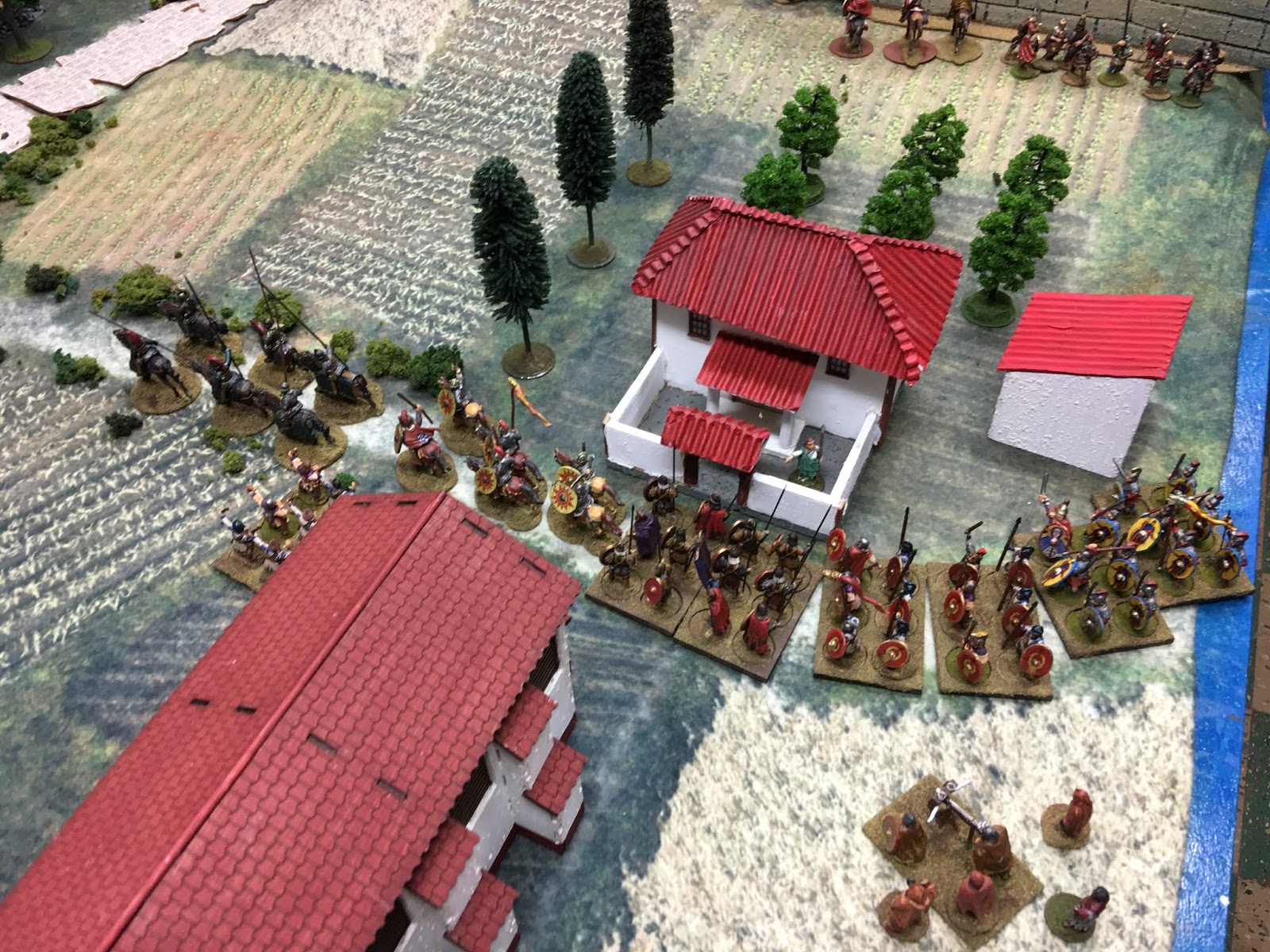
This is one side of the table, representing the main area of the province of Ruritania.  One corner contains the provincial capital of Colonia Stresona.  There are also a few villages, villas, a state-owned granary (taxes were often paid in kind in the late Empire), a church, and a settlement belonging to the Roman-allied (at least initially) Sarmatian tribe, the Ruritanii, for whom the province is named.


The other side of the table will be the frontier area, dominated by the might Ister Flumens.


Here's some shots of the various forces involved:

 Queen Amalsuntha of the Gepids

Aurelius Victor, an Imperial pretender

 Victor is supported by a sizable army

 The Comitatenses of the Dux Ruritanicum

 The Sarmatian Ruritanii
Huns and their Slavic allies 

Less than enthusiastic Limitanei

Some "action" shots:

Warning signals from the border outpost

Defending the river

Breaching the river defenses

Goths engaged with Roman troops


The city prepares for the barbarian onslaught